Written by : Diego Lapetina
Read Time: 19 minutes
A brand positioning framework, run against our own market research on the Peach & Lily Zombie Cream — and why the research lost
Every brand team has sat in this meeting. The research deck lands. Someone highlights the single differentiating fact, almost always a price point, almost always “the only X under $Y in the category.” It goes on a two-by-two. The axes get labeled. The client nods. The deck is filed under Strategy.
The fact is real. It is verifiable. It is probably correct.
It is also the one thing a funded competitor can match inside a quarter without a strategy meeting.
That gap — between a true differentiating fact and a defensible competitive position — is where most brand strategy quietly fails. Not because the research was bad. Because nobody in the room asked whether a fact about this week’s market is the same thing as a position that survives next quarter’s competitive response. They are not the same thing. A research brief that conflates them is not a positioning study. It is a summary with a chart on it.
What follows is a worked example. In August 2026 we ran two independent studies on the Peach & Lily Advanced Rebound Bioglow Zombie Cream: a market research study first, then a positioning study that was permitted to overrule it. It did. The map our own research proposed scored an isolation of 0.333. The map the positioning framework chose scored 0.887 — 2.7 times stronger, and unchanged when we redrew it with an unflattering roster.
This is the method, layer by layer, with the numbers each layer produced.
Disclosure. Both studies were prepared using only publicly available information. Peach & Lily was not contacted. There is no commercial relationship between AtomicPom Labs and Peach & Lily. At the date of study the product had been on sale for roughly two weeks and carried three reviews. Nothing here is an endorsement, a verdict on the product’s efficacy, or a claim about the company’s internal plans.
The mistake is not doing bad research. It is treating research findings as positions.
Three kinds of finding get promoted to positions more often than any others: price leadership, category firstness, and ingredient exclusivity. Each fails the same test for a different reason.
Price leadership fails because it requires continuous operational commitment to hold, and in this category it does not even require that much to break. A competitor does not need to restructure a supply chain. It needs one product meeting and a decision to absorb margin on a single SKU for two quarters. The gap closes. Three of the companies on this roster could do it without noticing the cost.
Category firstness fails because it is a fact about the calendar, not about the consumer’s memory — and memory is where positions live. The pioneer-advantage literature has been arguing about this since Golder and Tellis re-examined the original market-share studies in 1993 and found that pioneers fail far more often than the surviving-brand samples suggested. The finding is contested and the exact percentages vary by sample. The direction does not: arriving first is not the same as being remembered first.
Ingredient exclusivity fails fastest of all, because any active that can be sourced can be approximated, and reformulation cycles in beauty are measured in months.
The Peach & Lily case is useful precisely because our market research found all three of these and correctly identified them as differentiating. The positioning study’s job was to work out which of them, if any, could survive a competitor’s response.
What the market research found, and why it was right but not enough
Good market research describes the current state of a market with enough precision that a strategist can see the shape of the opportunity. Ours did that. The problem was not the quality of the findings. It was that the findings, taken as a set, pointed toward a position the market could dissolve inside a single competitive cycle.
The market nobody has sized — a finding, not a gap
No analyst has sized senolytic skincare as a consumer category. The published “senolytics market” figures, roughly $4.5bn globally, measure pharmaceutical drug development and clinical-stage compounds. Quoting that number for a face cream would overstate the opportunity by an order of magnitude.
So the report does not quote it. The category has to be argued from first principles and from the behaviour of the handful of brands already in it. That absence is a structural fact about this market, and stating it plainly is what separates a market research report from a pitch deck. There is no analyst figure to point a board at, and pretending otherwise is the easiest lie in this business.
The pricing ladder — a research finding that restructures the competitive set
Shelf price hides more than it reveals, because jars differ in size. Converted to cost per 100ml, the ladder reads:
| BRAND | Per 100 mL |
|---|---|
| COSRX Advanced Snail 92 | $17 |
| Beauty of Joseon Dynasty Cream | $48 |
| Olay Regenerist Micro-Sculpting | $60 |
| Peach & Lily Zombie Cream | $118 |
| Drunk Elephant Protini | $144 |
| Tatcha The Dewy Skin Cream | $148 |
| Charlotte Tilbury Magic Cream | $210 |
| OneSkin OS-01 FACE | $234 |
| Estée Lauder Revitalizing Supreme+ | $240 |
| Timeline Mitopure Dewy Cream | $400 |
| Dr. Barbara Sturm Face Cream Rich | $480 |
| Augustinus Bader The Rich Cream | $630 |
Ten of the seventeen products on the full comparison cost more per 100ml. Every single brand making a cellular claim does. The nearest of them, OneSkin, is 2.0 times more expensive,
Then the research produces its best reframe. A jar lasts six to eight weeks, which puts the cream at $354 to $472 a year. At that figure it is not competing with the cream on the next shelf. It is competing with prescription tretinoin at $112 to $480 a year — a route to the same outcome that carries a doctor’s authority. That is a research finding that redraws the competitive set, and no amount of shelf-level thinking produces it.
And then the research runs out of road. OneSkin at $234 per 100ml is a fact about this week. Its price is a decision one email thread can change.
The vocabulary gap — unowned, unbought, and diverging
The third finding is the structurally interesting one, and it is worth stating with the numbers attached.
Senolytic draws 1,900 US searches a month. No skincare brand ranks for it. No skincare brand advertises against it. The organic results are Mayo Clinic, Nature and the medical press. Zombie cells — the consumer translation — draws 1,600 a month at a keyword difficulty of 29, which is to say it is genuinely available. Senescent cells draws 2,400. Senolytic skincare and zombie cream draw 20 each, which tells you the category has no consumer-facing search behaviour yet at all.
Peach & Lily is not bidding on any of it. Its paid search budget, roughly $2,300 a month, goes entirely to its own brand name.
Skin longevity is the exception, and the warning. It draws 390 a month, and it is not unowned: Estée Lauder ranks first for it with a dedicated page. The softer, friendlier, more marketable phrase is already taken by the one competitor in this market that cannot be outspent.
Set against the incumbent vocabulary, the scale of the education problem becomes legible. Retinol cream draws 60,500. That is a 32-fold gap between the technical term and the category it is trying to displace.
The trend lines diverge, and this is the part that matters. Senolytic has softened from 2,400 monthly searches in 2023 to 1,900 now. Skin longevity has gone the other way, from 30 to 390. The consumer-facing framing is growing. The technical one is not.
The research correctly identifies that the vocabulary is unowned and unbought. What it cannot answer is which of the two available words is actually holdable. That requires a different kind of analysis.
The positioning study: a method permitted to overrule the research
Most positioning work takes the research’s recommended differentiator and builds a map around it. That produces a map which confirms the research. It cannot do anything else — the conclusion was fixed before the first axis was drawn.
The method below runs the map before selecting the pair, and tests whether the research’s own recommendation survives. Seven layers. Each produces a specific output. They are not options; they are gates. A candidate that fails Layer 1 does not reach Layer 4.
Layer 1 — Facts are not positions
Every candidate differentiator runs through one question: how long, and how much, would it take a well-funded competitor to close this gap?
Price gap: one product meeting, one quarter. Ingredient exclusivity: one reformulation cycle. Category firstness: irrelevant the moment the category exists, because the consumer does not remember who arrived first — they remember who explained it best.
Call it the quarter test. If a competitor can match a differentiator inside a quarter, it is a fact about today.
Note what survives this test and what does not. The price fails. The word does not — but for an unusual reason. Owning “senolytic” is not defensible because it is hard to copy; it is trivially copyable. It is worth owning because the cost of buying the category’s own name today is negligible and the cost of buying it back later will not be. That is a land-grab argument, not a positioning argument, and the two should not be confused. The positioning study keeps them separate.
Layer 2 — Score the whole market on many axes, not the two you already like
We scored 15 candidate axes across the full brand roster: Mechanism Naming, Premise Novelty, Threat Framing, Encounter Mode, Proof Locus, Cost of Entry, Tolerance Promise, Result Timing, Aesthetic Register, Depth of Address, Lexical Choice, Regimen Gravity, Permission Source, Age Address, and Explanation Staffing.
Breadth matters for one specific reason. The two axes you already like are the two most likely to confirm what you already believe. We arrived with a hypothesis about price and vocabulary. Running 15 axes forces the analysis through dimensions that were not in the hypothesis, and the ones that matter are usually the ones nobody expected.
The instinct to narrow quickly is understandable. It is also where most positioning maps go wrong before they are drawn.
Layer 3 — Kill pairs that measure the same thing twice
Fifteen axes produce 105 possible pairs. Twelve were rejected on correlation alone.
Mechanism Naming and Depth of Address correlate at +0.96 — a brand that names a mechanism is describing tissue by definition. These are not two dimensions; they are one dimension wearing two labels. Mechanism Naming and Premise Novelty: +0.91. Mechanism Naming and Threat Framing: +0.86. Encounter Mode and Permission Source: -0.75, because brands built on a named clinician sell direct rather than at mass shelf.
A perceptual map built on correlated axes looks two-dimensional. It is a single-axis ranking drawn twice. It appears to show spread; it shows compression.
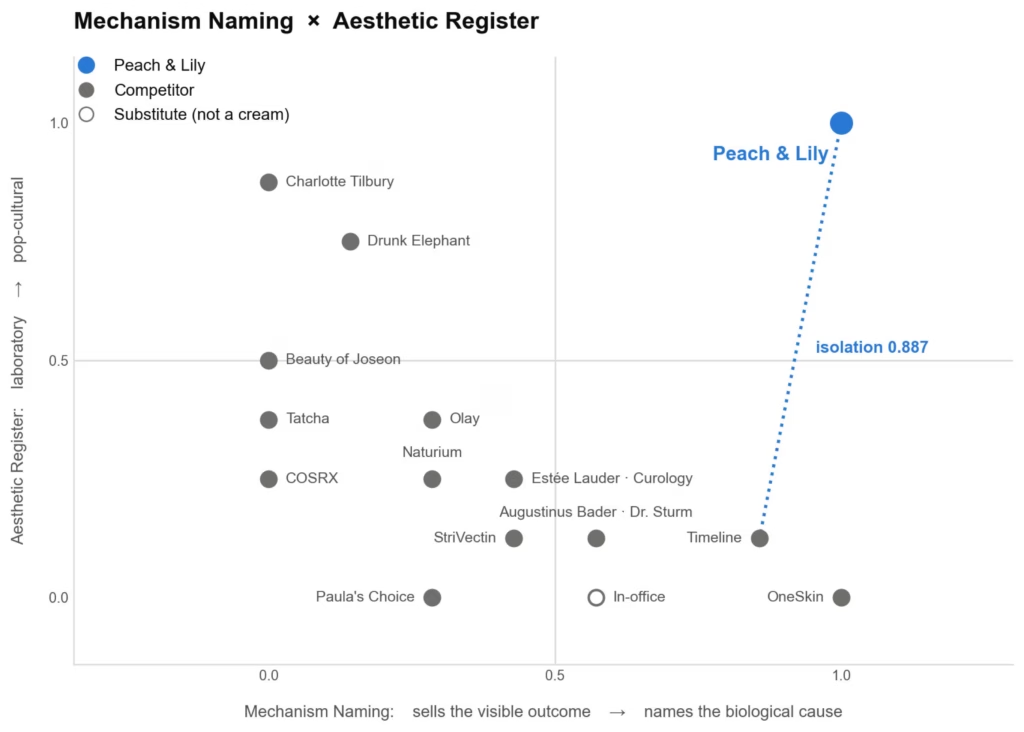
The two axes we chose — Mechanism Naming against Aesthetic Register — correlate at -0.23. That is the number that makes the map a map.
Layer 4 — Redraw the map with an unflattering roster
This is the step most positioning work skips, and it is where most positioning maps are quietly fraudulent.
Cost of Entry against Tolerance Promise scored 0.686 on a roster of cellular-claim and prestige brands only. That looks like meaningful isolation. Restore the cheap Korean creams that sit on the same physical shelf — COSRX at $17 per 100ml, Beauty of Joseon at $48 — and it collapses to 0.274. A fall of 0.413. Those brands are both cheaper and gentler, so the isolation was an artifact of who was left out of the room.
The winning pair did not move at all: 0.887 on a roster of 17 brands, 0.887 on a roster of 8.
That is what a real position looks like. It holds when you add the inconvenient competitors. A position that only exists when the cheap options are excluded is not a position. It is a curated slide.
Layer 5 — Perturb every score and re-run
The honesty disclosure belongs here, stated plainly rather than buried in an appendix.
The 0-to-10 axis scores are analyst judgment read off the research report. They are not measurements. There is no instrument that produces a 7.3 for Aesthetic Register. An analyst read the brand’s visual language, its copy register and its channel behaviour, and assigned a number.
What the arithmetic buys is consistency. Every score is applied by the same hand against the same criteria, which makes the reasoning auditable and — more importantly — arguable. A client who disagrees with a score can argue it, and the map recomputes. That is a feature. An agency presenting these scores as objective measurements is selling false precision. Saying it out loud is what lets a client engage with the map instead of nodding at it.
So we stress-test the judgment. Every score moved by up to a full point, 2,000 runs. Median isolation held at 0.686. Fifth percentile: 0.547. The client remained the sole occupant of its quadrant in 91.4% of runs.
The position is not brittle. It survives analyst error. It would survive a different analyst.
Layer 6 — Price the breach before it happens
This is the layer clients actually use in the room.
Soften the Aesthetic Register score and the position degrades on a known curve: at 8 it holds at 0.869, at 7 it holds at 0.728, at 6 it is materially weakened at 0.589, at 5 it is gone at 0.452. The breaking point is below 7.
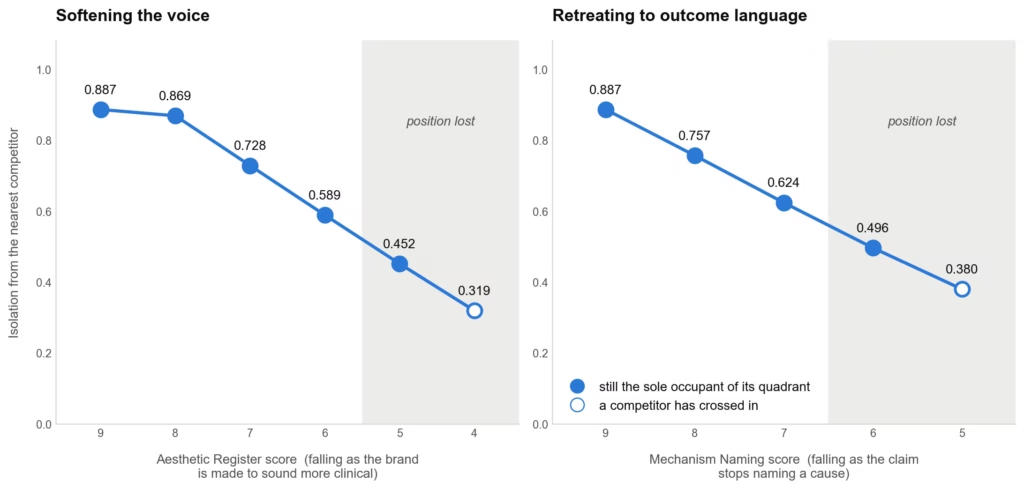
Mechanism Naming has less room. At 8 it holds at 0.757. At 7 it is already weakened at 0.624. At 6, gone. One point of tolerance, not two.
And if both drift together — the realistic failure mode, where a launch is judged too odd and quietly normalised toward the category mean — isolation reaches 0.515 and the nearest neighbour becomes Estée Lauder. The one company in this market that cannot be outspent.
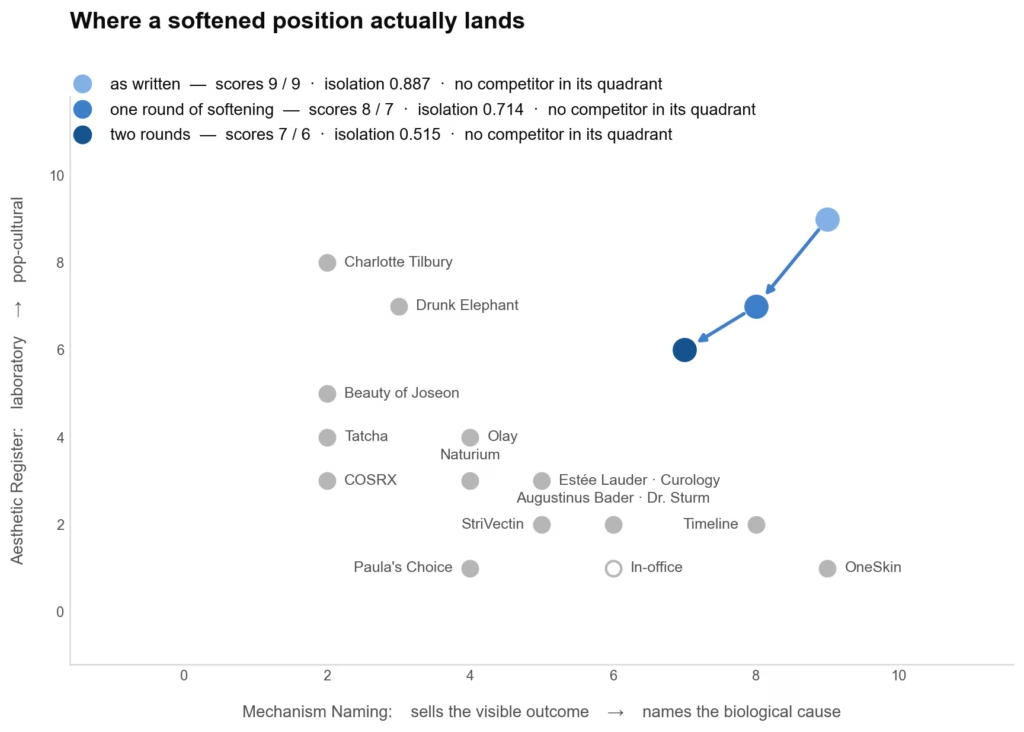
This turns “stay on brand” from a creative instinct into a number a committee can be held to. The creative director stops arguing taste. The strategist stops arguing theory. The number says: two points of tolerance on register, one on mechanism, spend them carefully. That is what makes a positioning framework a management tool rather than a document.
What it trades away is flexibility. A brand that accepts this map accepts that the professional, restrained version of itself is off the table in consumer channels. That is a real cost, and it should be priced rather than waved through.
Layer 7 — Find who holds the same corner in an unrelated category
Fourteen cross-category analogues were screened. Eleven were cut, and the cuts map the edges better than the passes: Nutrafol and Seed name mechanisms precisely in a clinical voice — the serious version of this position, and proof the register is a genuine choice rather than an inevitability. Liquid Death and Dr. Squatch hold the playful register with no mechanism at all, which is where this brand lands if the science softens.
Three passed. Mucinex made a cartoon of mucus. Squatty Potty explained colonic angle with a cartoon animal. Poo-Pourri explained an oil barrier through comedy about a taboo. Each names a real mechanism and presents it playfully. The corner is habitable.
But read their limits together and the finding inverts. Mucus can be seen. Constipation is felt daily. Odour is unambiguous. In every case the buyer already had direct evidence the antagonist existed, and confirmation within a single use that it had been dealt with.
Senescent cells are silent. There is no sensation of having them and no way for a buyer to confirm they have been cleared. The brand is dramatising an enemy nobody can feel.
This is not a campaign problem. It is the actual strategic brief, and it is more useful than any instruction to make the work louder. The job is to bind the invisible cause to a visible symptom the buyer already notices — skin that creases and stays creased, that looks tired when rested, that no longer springs back — and then to give a way of checking inside the first month.
That constraint does not appear in a research summary. It does not appear on a perceptual map. It appears when the method is built to look for it.
The map our research proposed, and why we rejected it
Our market research report placed the product alone on a cellular claim at an accessible price. That is true, it is well-evidenced, and it is the finding any competent research study would have produced.
Scored against the full roster, that pair reaches an isolation of 0.333 — 2.7 times weaker than the pair we chose. Its two axes also correlate at -0.52, so the map reads as a partial diagonal rather than a genuinely two-dimensional one. The nearest neighbour is OneSkin, which is exactly the brand the position was supposed to escape.
The axes are not wrong in isolation. They fail because they measure dimensions the competitive set is already free to move along. Price is a decision. A cellular claim is a copy decision plus a supplier. Neither requires anything a competitor cannot arrange in two quarters.
Mechanism Naming against Aesthetic Register survives the same test without moving, and the reason is structural rather than clever. A competitor cannot match a mechanism name without reformulating and re-registering claims. It cannot match an aesthetic register without rebuilding its brand voice in public, in front of the customers who bought the old one. Both cost time. Both cost commitment. That is what a position is: a place in the market that costs something real to reach, and therefore costs something real to copy.
The research was right about the facts. The positioning study was right about which facts were holdable. The two conclusions are not in conflict — they are sequential. Research produces the raw material. The positioning framework determines what can be built from it.
The search data: proof the two studies are one system
The vocabulary question is the cleanest demonstration that running both studies together produces a decision neither produces alone.
The research layer found that senolytic was unowned and unbought. In isolation, that reads as a straightforward opportunity: a technical term with no competitive pressure, sitting in front of a consumer base increasingly interested in mechanism rather than mood.
The positioning layer found something the research could not: that the other available word was already held. Estée Lauder ranks first for skin longevity with a dedicated page. That changes the decision entirely, because it means the friendlier term is occupied by the competitor with the deepest pockets in the category, while the technical term is free but softening.
Then the search data prices both. Senolytic, 1,900 a month and falling, difficulty 49. Skin longevity, 390 and rising, but defended. Zombie cells, 1,600 a month at difficulty 29 and effectively undefended by anyone in beauty. Retinol cream, 60,500, which is the education burden the brand would carry alone, since no competitor is spending anything to grow the category’s technical vocabulary.
Run separately, each of those is a slide. The research slide says the vocabulary is unowned. The positioning slide says the consumer-facing term belongs to Estée Lauder. The search slide says the technical term is softening while its consumer translation is wide open.
Run together, they are a decision: use senolytic as the category’s name in every channel starting with paid search, where it currently costs almost nothing, and use zombie cells immediately after it as the translation rather than instead of it. Do not use skin longevity, because using it means competing for someone else’s word. Do not lead with anti-aging, because that puts the product back on a ladder where it is mid-table.
That decision cannot be made from one study. The research identifies the vocabulary state. The positioning analysis identifies which state is holdable. The search data prices each option. Each is necessary. None is sufficient.
What this means if you are deciding whether to commission both
Anyone weighing paired research-and-positioning work already has the bad deck. They know what a research summary looks like. They have seen the two-by-two with the price point on it. The real question is whether there is a structural difference between that deliverable and what a positioning framework produces.
There is, and it is specific.
A research summary describes the current state of a market. It is accurate as of the date it was produced. It identifies facts, some of them differentiating. It cannot tell you which of those facts will survive a competitor’s response, because that question requires a different method.
A positioning framework tests durability. It rejects maps that measure the same thing twice. It rejects isolation that depends on who was left off the roster. It stress-tests analyst judgment across 2,000 runs. It prices the breach before it happens. And it finds the cross-category analogues that reveal whether the corner is habitable at all — and, in this case, what the real constraint turned out to be.
The Peach & Lily study produced a specific answer to a specific question: which axis pair produces the most durable isolation for this brand, in this category, at this moment. The answer was Mechanism Naming against Aesthetic Register at 0.887, unchanged under roster expansion, sole occupant of its quadrant in 91.4% of perturbed runs.
But the more valuable output was Layer 7. The silent-antagonist finding is not a positioning insight at all. It is a product and communication brief, and it says the brand cannot run the Mucinex play until the buyer can feel the antagonist being addressed.
We should be equally clear about what the studies could not do. No analyst has sized this sub-category, so no figure for it appears in either report. No persona document existed, so persona relevance was inferred from reviews, audience data and search behaviour rather than validated against research. The cross-category analogue scores are judgment read off public brand behaviour, a weaker grade of evidence than the roster scores, and they are labelled as such in the source document.
Here is the thing nobody in this industry particularly wants to say out loud: most positioning deliverables are designed to confirm the research, not to overrule it. The map is drawn around the finding the research already produced. The axes are chosen to make the client’s preferred position look isolated. The roster is curated to exclude the brands that would crowd the quadrant.
The math does not disappear. It just moves. A position built by excluding inconvenient competitors will meet those competitors in the market, and the map will not be there to help.
So the question worth asking before commissioning any positioning work is not “will this confirm our research?”
It is: is this method permitted to overrule it?
Take the last research deck you commissioned. Find the map it recommended. Then ask what that map scores when the roster is restored, the axes are tested for correlation, and every judgment is moved by a point and re-run two thousand times.
If nobody can tell you, you do not have a position. You have a fact about this month.
The Peach & Lily market research and positioning studies were conducted by AtomicPom Labs in August 2026 as independent research, using only publicly available sources. Search and advertising data: Semrush. Audience and traffic estimates: Similarweb. Price history: the Internet Archive.
What you need to know:
▸What is the “quarter test” in brand positioning?
▸Why did the positioning study overrule the market research?
▸What makes a brand position durable rather than just a differentiating fact?
▸What did the cross-category analogue research find?
▸Which keywords should a senolytic skincare brand target?
Subscribe to our Newsletter.
Every couple of weeks, notes straight from the trenches — plus the keys to our growing library. Subscribe today and the Skincare Launch Playbook lands first.
Drop your email and enjoy.