Written by : Diego Lapetina
Read Time: 11 minutes
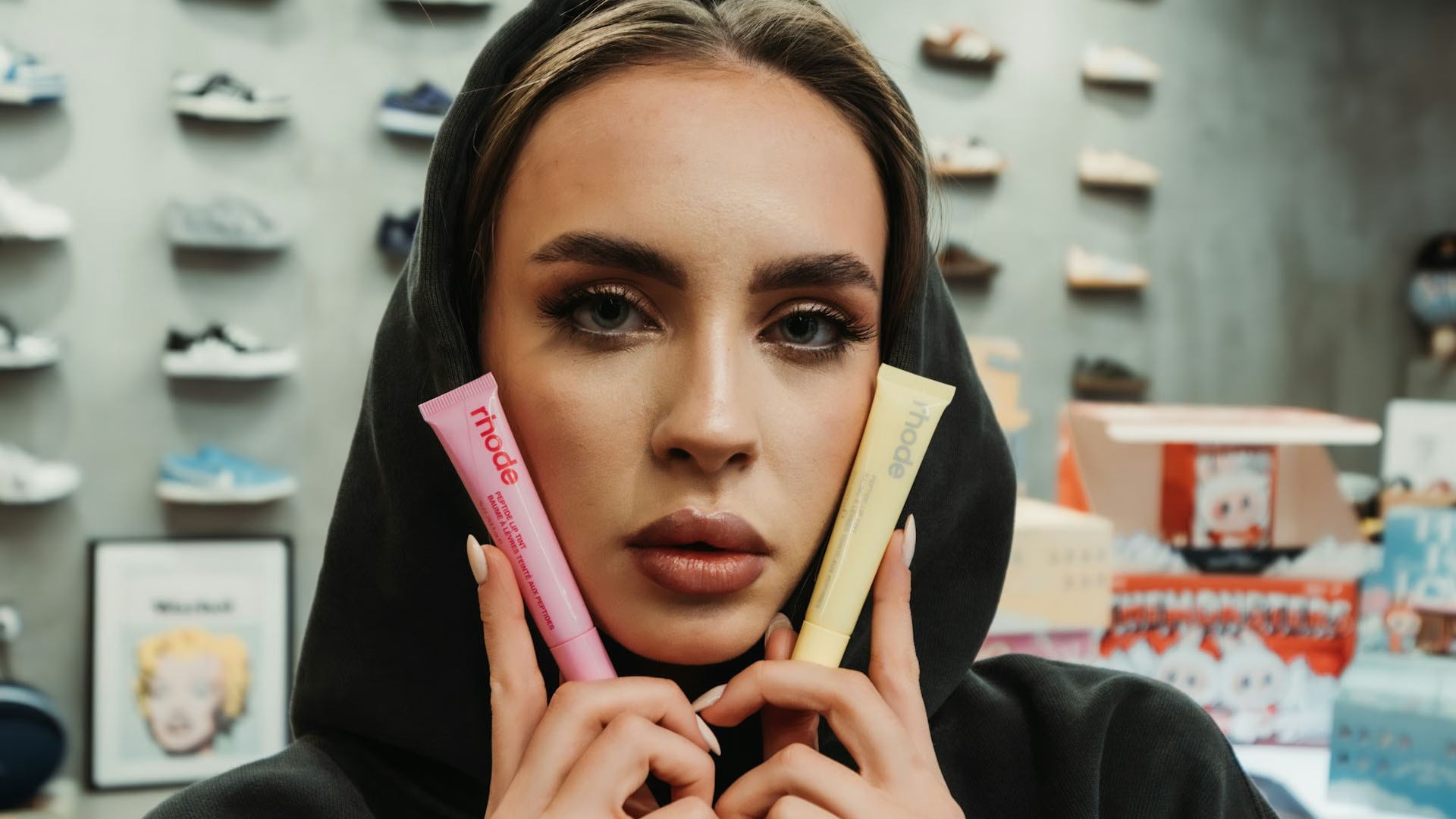
On rhode’s product page, there’s a tube of lip treatment tucked into the back of a silicone phone case. There’s a molded slot for it, right under the camera lenses. And the object makes a small, persuasive argument: this belongs next to the thing you already carry everywhere.
Then you look at the price of the business behind it. In May 2025, e.l.f. Beauty announced an agreement to acquire rhode for $800 million at closing, with another $200 million tied to future performance.
So why spend that much on a young beauty business when you already know how to make beauty products?
Because making the product and finding its audience are two different jobs. You can commission the first one. The second has to survive contact with people who owe you nothing.
So the price only makes sense next to the cost, the time and the uncertainty of building an equivalent business yourself, and next to what the buyer can do once it owns the thing. That’s where beauty M&A turns into a portfolio decision.
The cost of finding a winner
Imagine L’Oréal launching 100 brands every month. The lab work would be the easy part. Every one of those brands would need a reason to exist beside the ones already in the portfolio, a team to defend that reason, and retailers willing to give it shelf space.
Now imagine closing the failures. You pull stock, you reassign people, and you explain to a retail partner why this year’s strategic priority is next year’s discontinued line. Do that enough times and the bill goes well past the failed launches, because the group’s credibility and the attention its established brands need start paying for the experiment too.
An independent market absorbs a volume of experimentation that would wreck a single corporate portfolio. Founders test ingredients, identities, price points and routines with their own capital and their investors’ money. So the failures get spread around. And so do the discoveries.
Acquisition lets a corporation pick from the results. Part of the premium pays for uncertainty somebody else already removed, and the rest depends on what’s still possible. Neither part makes a winner permanent.
Which is why a company can be excellent at innovation and still buy someone else’s brand. An established brand has boundaries, and when you stretch it into a new category or price tier you weaken what customers already think it means. A separate acquisition gives you room without that compromise.
Internal incubation still earns its place where the group has a credible proposition and can live through the learning period. It comes down to where the uncertainty sits.
| Route | What the company gains | What it still has to solve |
|---|---|---|
| Build internally | Control from the beginning | Demand discovery, brand permission and management capacity |
| Partner | Access without full ownership | Incentive alignment and dependence on another operator |
| Invest progressively | Learning and potential access to future ownership | Limited control and a potentially higher price later |
| Acquire | Ownership of an operating business | Valuation, integration and the next stage of growth |
Waiting lowers the uncertainty and raises the price. Moving early flips that trade. Nobody gets certainty for free.
The premium has to leave something for the buyer
Church & Dwight’s Touchland announcement put the price at $700 million at closing, with up to $180 million more depending on 2025 sales. The business had about $130 million in trailing sales and $55 million in adjusted EBITDA through March 2025.
That’s roughly 5.4 times revenue upfront. But the better question is what those earnings become under a different owner, and how much of that improvement the seller has already been paid for.
The buyer described strong repeat purchasing and plans for more international expansion. And that’s a coherent thesis: people already prefer the product, and there’s distribution left to build. It still has to hold up outside the press release.
Here’s the thing. The group commits capital now against cash it expects to collect over years. More retail doors only create value if the extra sales survive retailer margins, local marketing costs, returns, and the inventory it takes to keep shelves full. A rollout can grow revenue and still eat the cash that was supposed to repay the investment.
And the negotiation gets harder when the seller wants to be paid today for growth the buyer plans to create tomorrow. Getting a brand to its potential takes money, time and execution, so the price has to leave the buyer enough of the future gains to make the effort worth it, with room for things to go wrong. Would the deal still work if international expansion took two extra years? What if customers bought less often than expected?
Repeat purchasing sits inside that math. A product running out creates the chance of another sale, but the customer still has to choose it again, so buyers need to know whether people come back at full price and what it costs to bring them back. Retail works the same way. Getting on the shelf is step one, and the doors only pay off when product sells through at a healthy margin and retailers reorder.
More brands, same risk
Buying brands is supposed to spread risk, and it does, as long as the brands don’t all lean on the same thing.
A prestige skincare brand, a fragrance house and a makeup label can all depend on the same affluent shopper, the same travel corridor, the same retail account. When that demand slows, three logos protect you about as well as one.
ELC’s fiscal 2024 results show it. Dr.Jart+ more than doubled sales in EMEA and grew double digits in the Americas, and its overall sales still fell, mostly because of weakness in mainland China and Asia travel retail.[4] So the country count tells an acquirer very little. What matters is whether the new brand brings a new customer budget, a new channel or a new purchase occasion, or whether it fights for money already going to a house name you own.
How the buyer pays matters too. e.l.f. arranged to borrow $600 million to fund the cash portion of the rhode deal. If rhode grows slower than planned, the interest is still due. So the deal has to work twice, as a brand investment and as a financial commitment, and no number of brands insulates a beauty company from macroeconomics.
What scaling can preserve and what it can break
The corporate advantage is big when a brand’s demand has outgrown its infrastructure. Existing regulatory teams, manufacturing relationships and retail access remove constraints an independent company would spend years working through.
CeraVe is the concrete example. L‘Oréal’s 2018 results reported expansion into more than 30 countries alongside continued double-digit growth in North America, and the brand’s dermatologist-developed positioning gave that expansion a coherent center. Distribution widened around a proposition people could recognize.
So the first job after an acquisition is to expand what customers already value. The buyer will change manufacturing, packaging or distribution, and those changes have to preserve the product experience and the brand’s identity. Formula performance, claims and positioning stay coherent while packaging rules, channels and communication adapt locally. A brand name alone won’t hold that together across a global rollout.
But the pressure to grow pulls management the other way. More stores and more launches look like progress, and they also take more inventory. If customers don’t buy enough, the company is sitting on stock it has to clear, and repeated discounts make it harder to sell at full price later.
Growth also disappoints for reasons the buyer doesn’t control. Dr.Jart+ ran into that weakness in China and travel retail, and in fiscal 2024 ELC recorded a $471 million write-down related to the brand. In plain terms, it admitted the business’s prospects no longer supported the value sitting on its books.
One way to manage that is to buy gradually. ELC first invested in DECIEM in 2017, took majority ownership in 2021 and completed the acquisition in 2024, for a total of about $1.7 billion, net of cash. That gave the two companies years of working together before full ownership. The trade-off is shared control at first, and later purchases that get more expensive as the business grows.
And when a whole brand stops making sense, individual products can still have a future. After Becca closed, its Under Eye Brightening Corrector and Shimmering Skin Perfector Pressed Highlighter carried on through Smashbox. That recovered some value, though it doesn’t tell us whether the original acquisition paid off.
So buying the brand is only the first decision. The owner keeps deciding where to expand, when to commit more capital, and what to save when the plan stops working. And the hardest of those decisions is who gets to make the rest.
Keep the judgment that created the value
This is the part integration plans get wrong.
An acquired team carries something the product catalog can’t capture, which is judgment about what deserves to exist next. The formulas transfer on closing day. The judgment only stays if the people who have it keep the power to use it, and that matters most once the original bestseller matures.
The rhode announcement gave Hailey Bieber continuing responsibility for creative, product innovation and marketing, plus an advisory role to the combined companies. Church & Dwight said it plans to keep Touchland’s founders and employees and keep the Miami base. So both deals wrote continuity into the announcement. Good.
But keeping the people is only part of keeping the capability. A founder can stay on the payroll while every meaningful decision drifts into committees that never built the customer relationship.
So settle a few things before integration starts, in writing. Who approves or rejects a formula change that improves margin but changes the experience? Who can say no when a retailer asks for more launches? Who protects a positioning choice when a broader message would be easier to get approved?
Because a buyer can keep every single person and still dismantle their authority. And when that happens, the group has paid a premium for a brand and then removed the thing that made it worth a premium.
There’s value flowing the other way, too. The acquired team can help the parent rethink how it develops products or runs older brands. DECIEM’s recruitment for an Origins brand role covers global campaigns, consumer understanding and creative positioning. My reading is that this points toward capability sharing across the portfolio. It doesn’t prove a turnaround yet.
That’s the more ambitious acquisition case, where the group gets a business and also a team whose methods improve other businesses it already owns. It needs practical arrangements though, like shared projects, access to decision-makers, and permission to challenge how things have always been done. Shared technical resources and purchasing power make the team stronger. Creative decisions need enough independence to keep producing the difference the group paid for.
The deal should solve a specific constraint
For an established founder, the useful question is what the next owner would make possible. Inventory funding, retailer access and international execution all need different resources. Some of those constraints justify a sale, and others get solved with financing or a commercial agreement.
For the buyer, the matching question is why ownership creates more value than access. If a distribution partnership delivers most of the opportunity, then paying for the whole company needs another justification. And if the missing asset is a team’s product judgment, the integration plan has to protect that team’s ability to use it.
| Buyers need to establish | Founders need to assess |
|---|---|
| The portfolio gap and why this owner can close it | The growth constraint and which partner can remove it |
| Incremental cash generation after execution costs | Whether expansion improves the underlying business |
| Exposure to slower growth and shared market risks | Whether financing and operational capacity can support the plan |
| Capabilities to integrate and decisions to leave local | The authority and resources needed to keep creating value |
Both sides should be able to describe the next phase without leaning on “more doors” or “more products” as the strategy. The plan has to explain why demand will follow, what it’ll cost, and which decisions keep the brand recognizable.
Build a business with choices
The independent market runs experiments no conglomerate could sensibly run inside its own portfolio, and corporate ownership then gives the winners the infrastructure to reach demand they couldn’t serve alone. That exchange gets expensive when the buyer mistakes attention for durable demand, pays away the future upside, or standardizes the judgment that made the brand worth buying.
For founders, a strong business creates choices: stay independent, partner, take investment or sell. For corporate leaders, the job is knowing where ownership adds enough value to justify the cost, and where restraint is the better investment.
At Atomic Pom Labs, this is the work we do with founders and brand teams long before anyone names a price. We sit where brand strategy and product development meet, so the questions are practical. Where does the category still have room? What can this product credibly deliver? And if someone swapped the hero formula for a cheaper one tomorrow, would the customer notice? If the answer is yes, that’s what a buyer is paying for, and it should be protected on paper before an offer ever shows up.
Go back to that phone case. Any contract manufacturer can fill a tube of lip treatment. Somebody at rhode decided it belonged on the back of your phone, right under the camera, and a lot of people agreed. e.l.f. agreed to pay $800 million upfront for a business built on decisions like that one. Whether it earns that back depends on who’s still allowed to make them.
What you need to know:
▸Did e.l.f. buy rhode?
▸How much did e.l.f. buy rhode for?
▸Why did e.l.f. buy rhode?
▸Who owns Touchland?
▸What is an earnout in a beauty acquisition
▸What happens to founders after a beauty brand is acquired?
Subscribe to our Newsletter.
Every couple of weeks, notes straight from the trenches — plus the keys to our growing library. Subscribe today and the Skincare Launch Playbook lands first.
Drop your email and enjoy.