
Thirty years of indie beauty data show founder visibility follows the sales channel, and never predicted which brands survived or sold.
Format: Research note (PDF)
Length: 15 pages, 20 min read
Published: November 2026
Cost: FREE
About this study:
Does a beauty brand need a famous founder? We went back thirty years to check. This research note compares the most-searched indie beauty brands across six five-year blocks, from Hard Candy and bareMinerals in the late 1990s to Anua, Biodance and Byoma today. Each brand is coded for how visible its founder was, which channel it grew through, what its hero product cost and how it ended up.
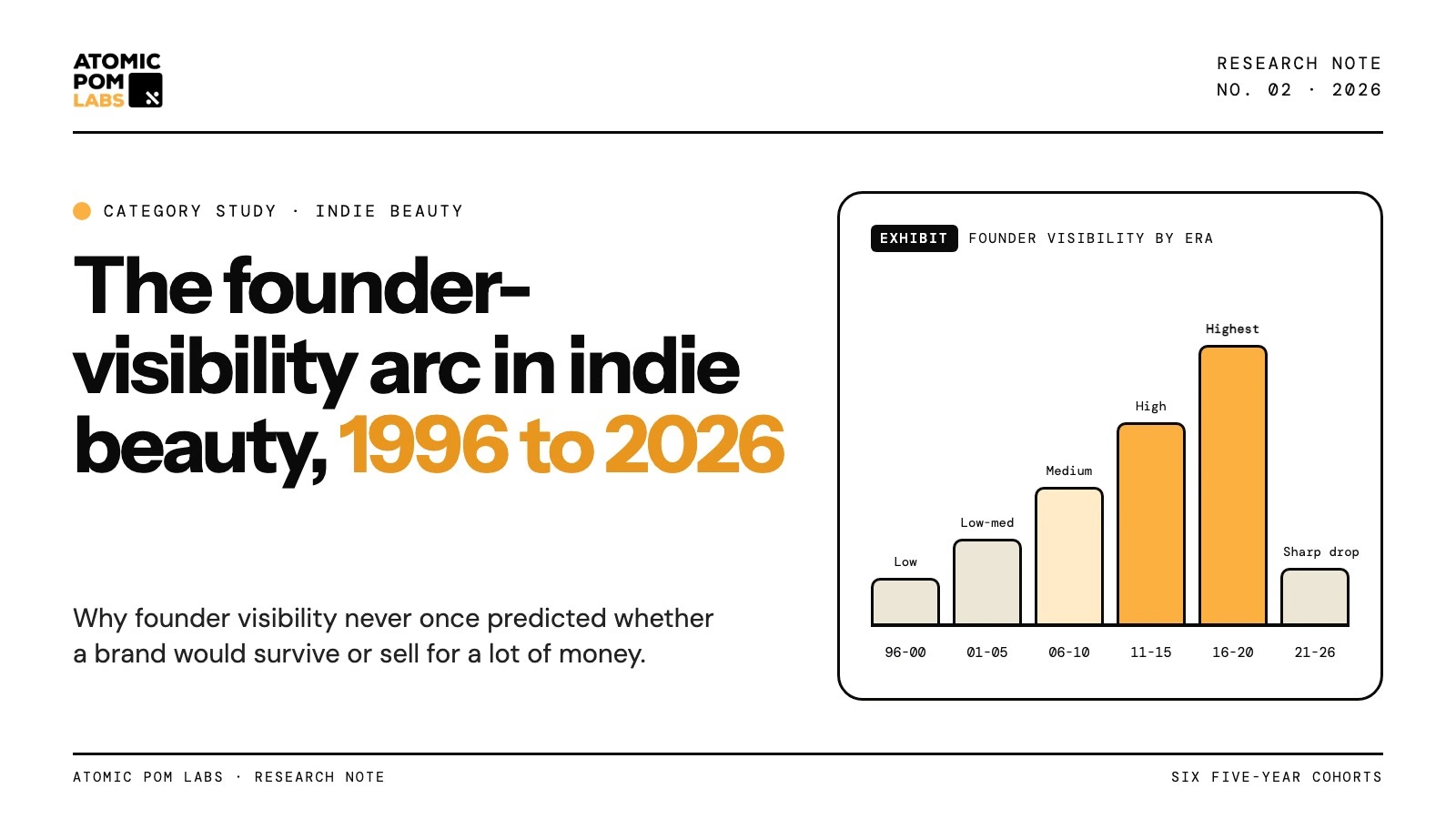
Founder visibility does trace an arc. It starts low in 1996, climbs through the QVC years, peaks with the celebrity founders of 2016 to 2020 (Rihanna, Kylie Jenner, Huda Kattan) and then drops hard once TikTok Shop takes over. But the arc follows the sales channel, and it never told you which brands would survive or sell well.
What the study found
- Founders got visible when the channel rewarded a face: QVC live selling, then Instagram. They went faceless when TikTok’s algorithm started rewarding the product demo instead.
- The Ordinary’s founder died in 2019 and Estée Lauder still bought the brand at a $2.2 billion valuation. Anua, a brand whose founders almost no shopper can name, says it passed $500 million in sales in 2025.
- Hero prices fell from $68 to $90 for prestige skincare in the Instagram years to $5 to $20 on TikTok Shop. The founder story was what justified the higher price.
- Buyers paid the biggest multiples for brands with a hero product people rebuy (IT Cosmetics at $1.2 billion, Too Faced at $1.45 billion) and wrote down the ones that ran mostly on fame.
How we measured founder visibility
Private revenue data barely exists for the early years, so we used visibility instead. Before 2004 that means press mentions in WWD, Allure, Cosmetics Business, Forbes and Vogue. From 2004 on it means share of search, the Google Trends measure Les Binet showed tends to lead market share by six to twelve months. Every block also includes brands that faded or plateaued, so the winners don’t get to tell the whole story. The calibration is coarse, and the caveats page says exactly where.
Questions this study answers
Do you need a founder-led beauty brand to succeed in 2026?
No. A visible founder stopped being necessary once discovery moved to TikTok Shop and Amazon. It still works when the founder already is a distribution channel, the way Selena Gomez is for Rare Beauty.
Why are K-beauty brands like Anua and Biodance faceless?
Because the feed sells the clip. Each of them rides one cheap hero product with a mechanism you can film, like a mask that turns clear over a few hours, and the product does the talking.
Does founder fame raise a beauty brand’s sale price?
Not reliably. Coty paid $600 million for 51 percent of Kylie Cosmetics in 2019 and later wrote the value down. Shiseido booked a goodwill impairment of roughly $310 million on its Americas business in November 2025, driven largely by Drunk Elephant.
The full note runs 15 pages, with eight exhibits and four recommendations for operators and investors. Leave your email and we’ll send you the PDF.
Who should read this:
- Beauty founders deciding whether to put their face on the brand
- Brand and marketing leads planning a launch for TikTok Shop, Amazon or retail
- Investors and acquirers pricing founder-led and faceless brands
- Trade journalists and analysts covering indie beauty and K-beauty
What's inside:
- Six cohort tables covering 29 brands, from Hard Candy to Anua
- Founder visibility coded by era, 1996 to 2026
- Three places the data contradicts the founder-story thesis
- How each channel era shaped hero product, price and brand architecture
- The entry-product play: a cheap, filmable hero that feeds a higher-margin line
- Four recommendations for operators and investors