

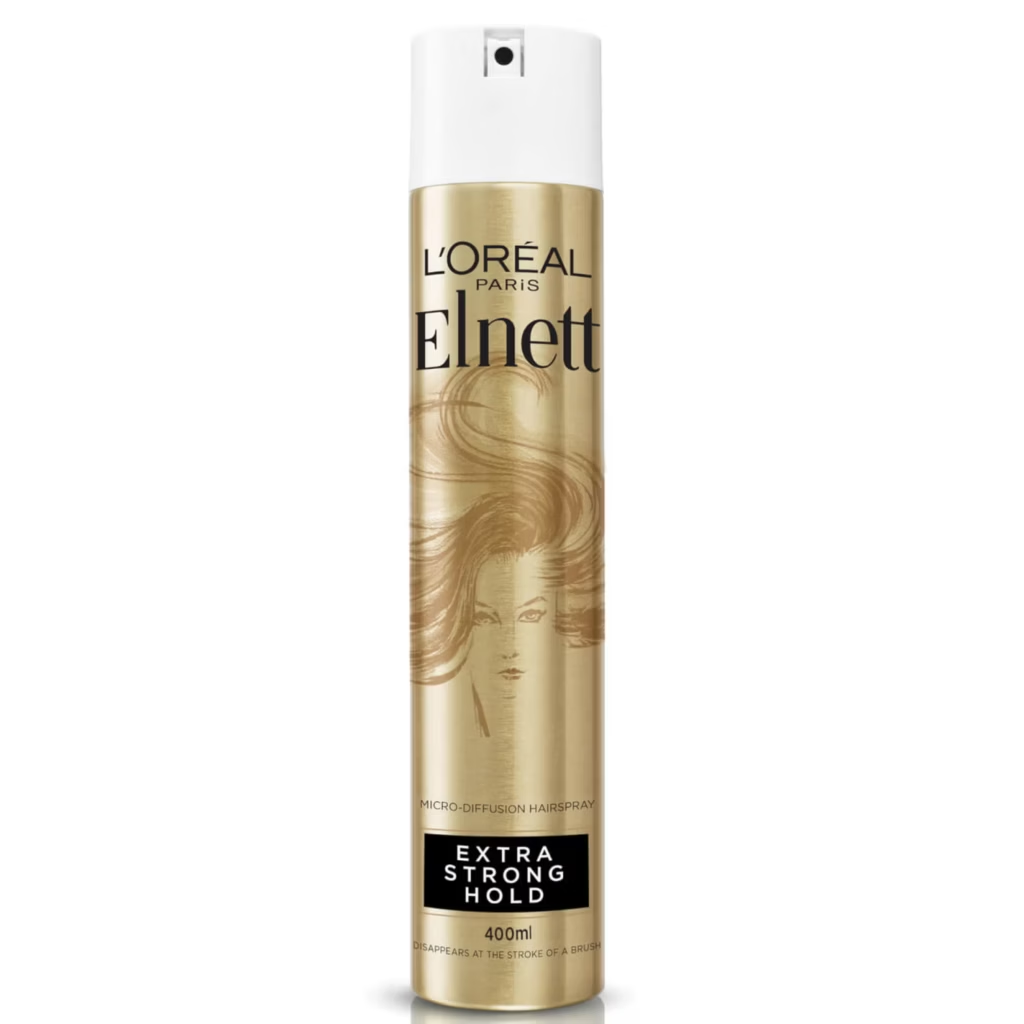
Before Nicola Kilner was the CEO of a billion-dollar beauty industry empire, she was a young girl in Nottingham, a silent witness to the domestic liturgy of the vanity table. There was a specific, sensory cadence to her mother’s routine: the rhythmic click of a gold L’Oréal Elnett can, the tactile heat of rollers, and the meditative application of Clinique’s three-step. It was the quiet precision of a woman assembling herself for the world.
It was beautiful. It was also, as Kilner would eventually realize, a performance staged on a foundation of incomplete information.
The Great Asymmetry
For decades, the beauty industry thrived on a kind of elegant gaslighting. The “magic” of a serum was usually just a $50 markup on a $2 ingredient—a margin protected not by scientific breakthrough, but by the careful maintenance of consumer ignorance. When Kilner and her late co-founder, Brandon Truaxe, launched DECIEM, they didn’t just launch a budget brand. They launched a challenge to a foundational industry assumption: the belief that the consumer needed to be protected from complexity.
They treated their audience as intellectually capable of engaging with the chemistry of their own skin. In an industry built on aspiration and mystique, it was a quietly radical act.
The Architecture of the “Real”
But transparency is a fickle muse. The history of business is littered with “honest” companies that failed because they forgot that a manifesto isn’t a supply chain. What set DECIEM apart wasn’t just what they said; it was what they built.
They abandoned the traditional beauty blueprint—outsourced labs, disconnected marketing firms, and glacial development cycles—in favor of a vertically integrated ecosystem. Chemistry wasn’t downstream from marketing; it was the spark. Designers weren’t there to polish a product; they were there to translate raw science into cultural legibility. And by housing ideation and formulation under one roof, they eliminated the institutional friction that keeps legacy brands trapped in eighteen-month loops.
The result was speed, but not the reckless kind. It was the speed that comes from alignment—from having every function of the organization oriented around the same core thesis. Products could be released in months rather than years. Pricing could reflect actual cost rather than aspirational positioning. And the brand could speak with a kind of authority that is difficult to fabricate: the authority of a company that genuinely understands what it is selling and why.
The Cost of Alignment in the Beauty Industry
There is, of course, a quiet tax on this kind of integrity. Vertical integration isn’t romantic. It’s heavy. It requires designers who think in systems and chemists who can balance regulatory nuance with brand promise. It demands talent density in a market that usually prefers celebrity ambassadors.
Most companies default to illusion because illusion is cheaper. It is operationally easier to refresh a package and hire a famous face than it is to build an engine. The industry’s most common strategy remains, in essence, a substitution: replace innovation with celebrity, replace transparency with narrative, and hope the consumer doesn’t notice. It is a strategy that works—until it doesn’t.
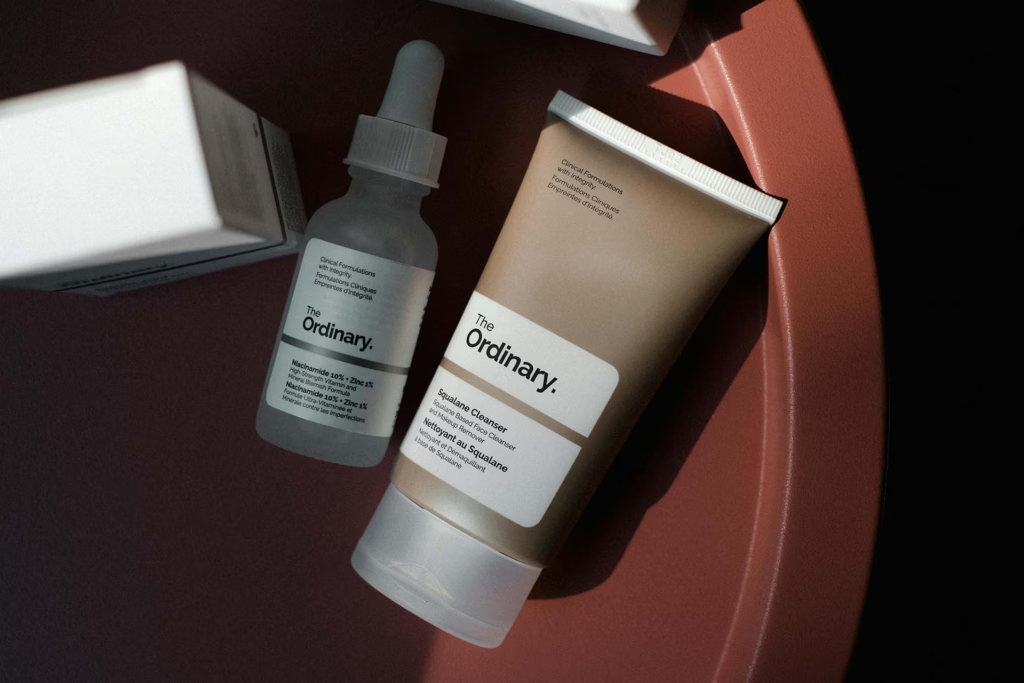
What The Ordinary demonstrated, with startling efficiency, is what happens when someone breaks that contract. The brand’s clinical packaging, its ingredient-forward naming conventions, its refusal to engage in the language of luxury—these were not aesthetic choices. They were epistemological ones. They reflected a belief that the consumer’s relationship to a product should be grounded in understanding, not faith.
A Familiar Architecture, Built from Necessity
The realization did not arrive with fanfare. It surfaced mid-conversation.
After years of building Atomic Pom Labs as a small-batch private label laboratory, Annie had become fluent in the usual constraints of the model. Brands would arrive with a Pinterest board and a margin target. Formulas were adjusted downstream. Packaging decisions were made in isolation. The website would come last, translating decisions that had already calcified.
And I was originally hired to design that website.
But during our first meeting, something became immediately apparent: the conversation wasn’t about fonts or layout. It was about structure—how formulation decisions shape brand narrative, how scent, viscosity, and color are not technical footnotes but identity signals. Over a year of collaboration, we noticed an unexpected pattern: we quietly assembled the very architecture we admired in DECIEM. Not by imitation, but by necessity. Formulation, design, positioning, and eCommerce are no longer sequential steps. They were simultaneous conversations.
I like to articulated the shift simply:
“It’s powerful to be able to give feedback on a product before it’s locked. When you can adjust color, texture, and scent while the brand identity is still forming, you’re not correcting—you’re composing.”
In a traditional structure, design reacts. In an integrated structure, design influences. This is the difference between decorating a house and building one. The brand feels coherent because it is coherent—not because someone made it look that way after the fact, but because every decision was born from the same conversation.
The Founder’s Dividend – Beauty Industry Reality
For a founder, the traditional model is a gauntlet of telephone. You tell the chemist you want “forest floor,” and they give you a green liquid that smells like a pine air freshener. You tell the designer it’s “minimalist,” and they give you a white box that doesn’t fit the bottle. By the time the product reaches the customer, the original vision has been diluted by a dozen hand-offs.
In the Atomic Pom model, that friction evaporates. By collapsing the development timeline from years to months, founders aren’t paying for eighteen months of committee meetings; they’re paying for three months of intensive composition. When the scent of the cream, the weight of the glass, and the UX of the checkout page all speak the same language, the consumer feels a rare sense of trust—and in an era of dupes and white-label clones, that coherence is the only thing that can’t be pirated. Because at Atomic Pom Labs the lab and the designers are talking from day one, problems are solved while they’re still sketches, not crises.
One recent partner—whom we can’t name due to an NDA, but we see you, Oregon—described the experience not as “hiring a lab,” but as “finding a brain.” This founder understood that the goal isn’t just managing a supply chain; it’s about bringing on a team capable of conducting the orchestra. By hiring experts to lead the symphony rather than just move the instruments, the entire process becomes smoother, more intentional, and far less prone to error.
This isn’t just a faster way to make a lipstick. It’s a more humane way to build a business. It allows the creator to remain a creator, rather than becoming a full-time logistics manager.

The Search for Symmetry Ends Here
The beauty industry is crowded with vendors who can follow instructions, but it is remarkably short on partners who can share a vision. Most laboratories see a formula; most agencies see a brand. Very few see the invisible threads that connect the two. And that’s why we created Atomic Pom Labs.
Because the future of beauty is not secrecy. It is not hype. It is not even transparency alone. It is structural honesty—where what you say, what you formulate, what you design, and what you sell are born from the same conversation. Innovation, when embedded in the organizational structure rather than appended to it, becomes a source of compounding advantage. Most companies treat research and development as a department. The ones that endure treat it as the organism itself.
We don’t just manufacture products. We build the operational architecture for the next generation of iconic brands.
And that conversation now has a name.