
When you first move away from home you rent an apartment. Usually, something simple and convenient. You don’t care much about the wall colors and the counter-top. At that stage, all you need is a fast way to get to work or university. Everything else is a bonus. No gym? I will walk. Eggshell paint? I will keep the lights off.
The years pass by and now you have finished university or got a promotion in your job. You start to have more income and your friends are starting to buy their homes. You visit an old pal from university and his new place has that amazing living room, with cozy colors and a fireplace that makes you wonder. I should upgrade my house.
So, next day you buy yourself a fireplace and install it on the corner. The wall now has a fresh coat of paint and makes everything feel perfect. So, you keep living there. Next you find a partner and get married. All of the suddenly, your perfect loft is too small. The morning routines are crowded with two people trying to use the same bathroom. And the toothbrushes don’t fit on the sink.
It’s finally time to move away.
And that’s when you realize that all the investment in the apartment will not move with you to the new place. The coat of paint, the new floor, the custom made countertops. And what’s worse, you need to pay to return the unit to its original condition.
Now, you might be thinking — why is a Cosmetic Agency talking about your first home?
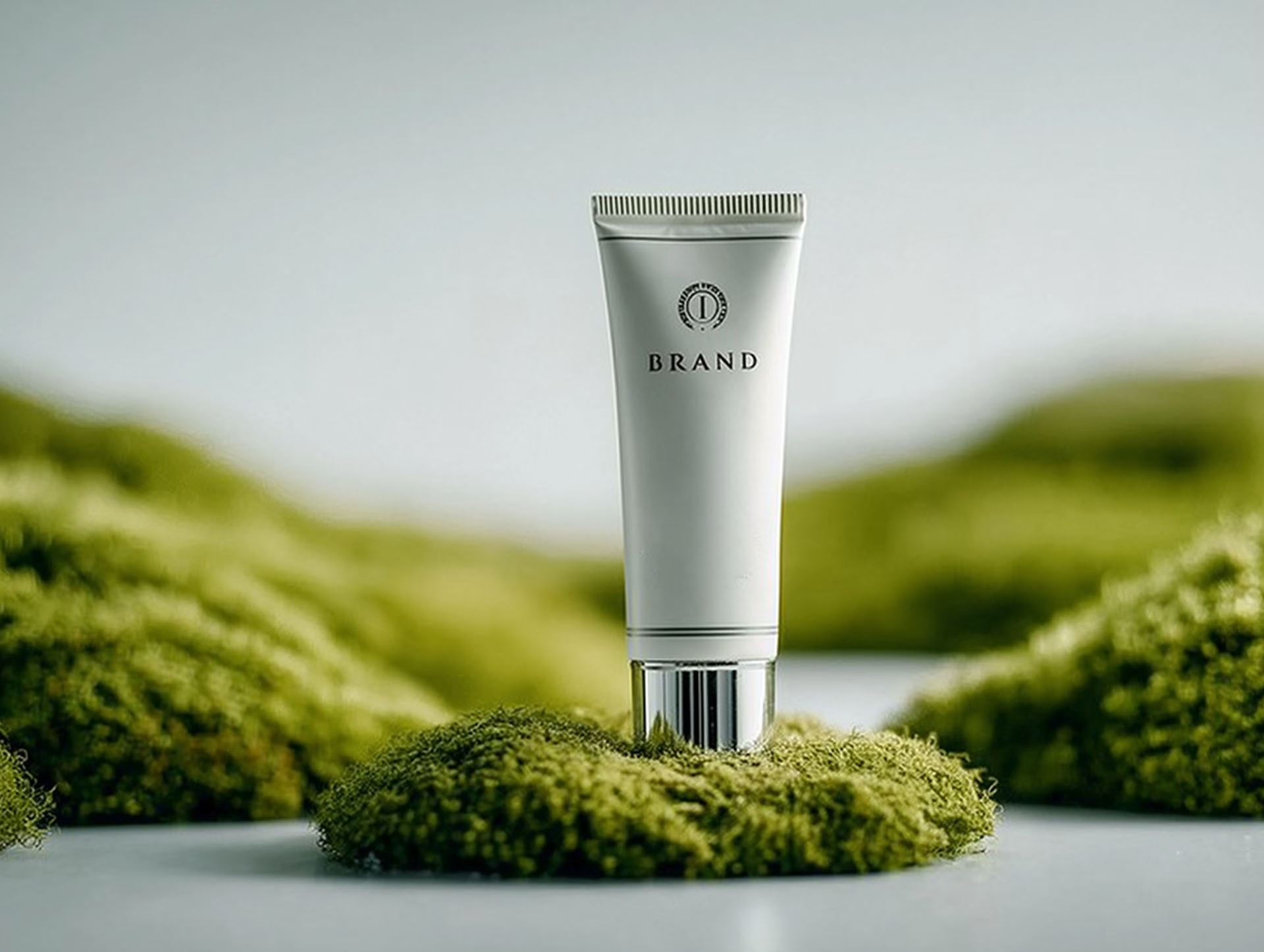
Because the same thing happens to founders every single day in the beauty industry. They find a private label lab. The lab hands them a catalog. They pick a base formula — already stabilized, already safety-tested, already sitting on the shelf waiting for someone to put a sticker on it. Then the lab says: you can customize it. And to a founder, that sounds like innovation. It sounds like ownership.
It isn’t.
What they’re really offering you is a choice of scent. Lavender or Eucalyptus. Maybe a pigment. Maybe 0.1% of a trendy active ingredient so you can put it on the label. Tweaks. Surface changes. The kind that make the product look different in a photograph but don’t touch the DNA of the formula. Because the core chemistry belongs to the lab. The Intellectual Property stays with them. You are a guest in their laboratory — and like any guest, you leave empty-handed when it’s time to go.
This is what the industry calls Private Label. And despite the name, there is nothing private about it. Fifty other brands could call that same lab tomorrow and order the exact same base formula. Same texture. Same efficacy. Different logo on the front. You are not building a product — you are renting one. And just like the apartment, everything you invest stays behind when you move out.
Private Label: The problem becomes existential the moment you start to scale.
Imagine you’ve built something real. A community, a loyal customer base, a revenue number that starts with a five. Investors show up. They want to know what they’re buying. They look at your hero product — the one your customers swear by, the one that drives sixty percent of your revenue — and they ask: what’s defensible here?
And you have to tell them that anyone with a phone and a minimum order quantity can duplicate it.
That’s not a brand. That’s a target.
Real brand protection is not a trademark. It’s not an NDA. Those are pieces of paper. A competitor with a bigger marketing budget doesn’t need to steal your formula — they just need to call your manufacturer. Real protection is what happens when your product cannot be replicated because it was never built from a catalog. It was built from scratch. From the molecule up. Where the texture, the scent, the way it absorbs into skin — all of it is yours. Where the Intellectual Property lives on your balance sheet, not the lab’s. That is what investors mean when they talk about a moat. Not clever copy. Not a pretty Shopify page. Chemistry that belongs to you.

And then there is the brand itself.
Most founders in this situation have the same problem. They have three agencies that don’t talk to each other. One handles the formula. The other handles the website. A third one handles the content. None of them know what the others are doing. The result is a brand that feels assembled rather than built — a generic template here, a stock image there, a product that promises innovation but traces back to a ten-year-old catalog stock.
The consumer feels it. They can’t name it, but they feel it. The same way you feel when you walk into someone’s home and everything is slightly off — the furniture doesn’t belong together, the colors don’t agree, nothing was chosen with intention.
The brands that endure are the ones where the chemistry, the visuals, the code, and the story all speak the same language. Where the website feels like an extension of the lab. Where the product is a technical asset that has its own visual story because it earned one.
At Atomic Pom Labs, we build that. Not the rented version. The permanent one.
We start with custom R&D — no catalog, no shortcuts, no base formulas that fifty competitors are already selling. We release the IP so that what you build stays on your balance sheet, not ours. And we build the brand architecture around the product, so the visuals and the story are as deliberate and science-forward as the chemistry underneath them.
You’ve outgrown the apartment. You’ve outgrown the convenient shortcuts, the generic templates, the labs that own the soul of your business while you own the logo.
You have two choices as you scale toward $10M. Keep renting — and hope your marketing budget can outrun the next brand selling the exact same thing in different packaging. Or start building something no one can duplicate with a single phone call.
It’s time to move out. Build the permanent home.